
Milk Pitchers for Moka Lattes: Three Small Jugs Compared
Published · By Art de Vivre Coffee
As an Amazon Associate, Art de Vivre Coffee earns from qualifying purchases. Amazon buttons below are affiliate links. Read our disclosure .
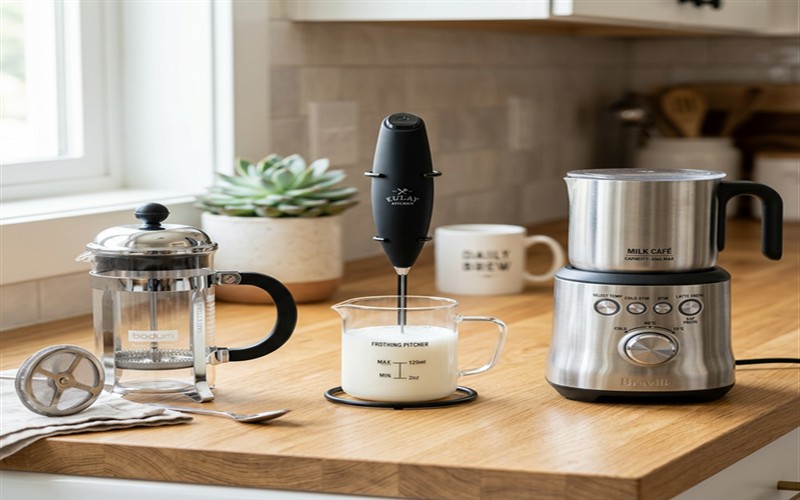
A small milk pitcher can make it easier to transfer and pour prepared milk into moka coffee. It is optional: if your current frother already pours neatly, you may not need another jug. The three products below are empty, unpowered vessels, not electric frothers.
Separate heating, frothing and pouring
A moka pot brews the coffee; prepare the milk separately. An automatic frother may combine heating and aeration, while a handheld wand needs milk prepared by another method. A pouring pitcher can be the final step, but it does not replace either job.
- Use a heating vessel or appliance approved for the method you choose. Do not assume a steaming pitcher is a saucepan or is suitable for a hob.
- If using a wand in a pitcher, check that the wand fits and follow its fill instructions. Allow room for foam and movement.
- Transfer prepared milk only when it helps your workflow; pouring it between vessels can alter the foam.
- If you already use a steam wand on another appliance, follow that appliance’s instructions. Moka brewing alone does not provide steam for these jugs.
Three small pouring jugs
Match the jug to one drink
Begin with the milk amount your recipe and frother require, then check that the vessel leaves room for expansion. You do not need to fill a 350–360 ml pitcher to its rim for one drink. Conversely, several large lattes may be inconvenient with a small jug; compare the usable batch size instead of assuming the nominal capacity is all available for frothing.
If a heated appliance has a minimum fill, respect that minimum. A smaller pouring jug does not let you operate an appliance below its allowed range. See our frother comparison for the differences between manual, handheld and heated models.
Pouring and cleanup
- Brew the coffee in your moka pot and prepare the milk with your chosen equipment. Keep milk out of the moka boiler.
- Set the drinking cup on a stable surface. Hold the pitcher by its handle and pour a little at a time, leaving headroom in the cup.
- Adjust the balance of coffee and milk next time before buying more equipment. A change in milk amount may solve the problem.
- Clean milk-contact surfaces after use and follow the exact jug’s care instructions, especially for coated finishes.
Questions before you buy
Does a milk pitcher heat or froth the milk?
No. These are unpowered pouring vessels. You need a separate, suitable method to heat and froth milk; a moka pot does not supply a steam wand.
Can I put one of these metal pitchers in the microwave?
Do not microwave these metal pitchers. Use a separate heating method and vessel approved for that purpose, following its instructions.
Is a 12 oz pitcher intended to hold 12 oz while frothing?
No. Nominal capacity is not a recommended frothing fill. Milk needs space to expand; follow the frother and pitcher instructions for your setup.
Will buying a pitcher guarantee latte art?
No. Milk texture, technique and the coffee surface all matter. This guide does not claim that any of these pitchers produces latte art on its own.
Sources and selection method
Product formats and features were checked against the sources below and the linked Amazon US listings on September 23, 2026. This is a research-based comparison, not a hands-on ranking. Prices and availability are shown by the retailer.
- De’Longhi DLSC060: material, spout and capacity
- Rhino Professional 12 oz: model, measurement marks and construction
- Fellow Eddy: size, finish, handle and spout
See how we review products and our editorial policy .