How to Make Cappuccino with a Moka Pot: Complete Guide
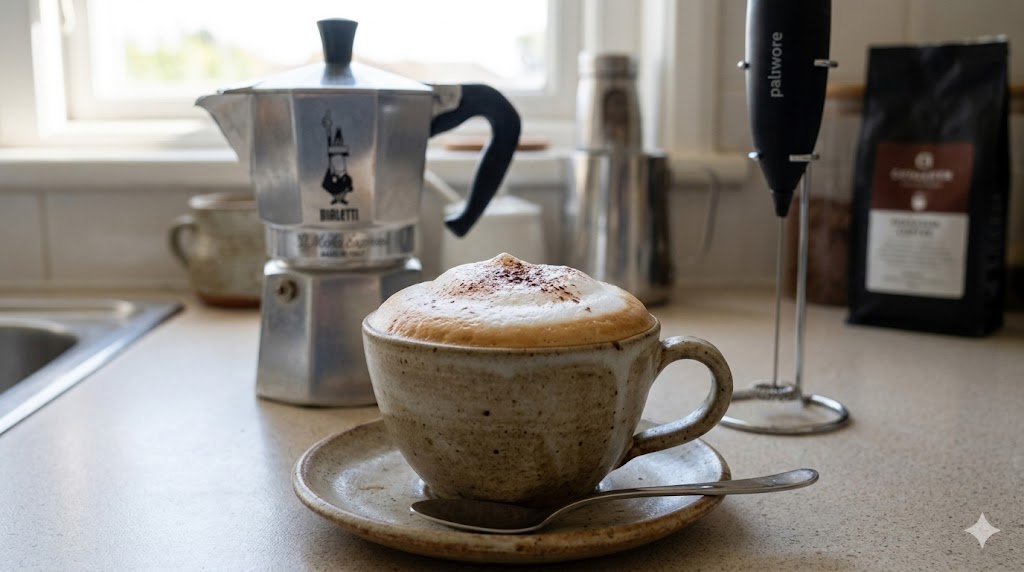
Make a cappuccino-style milk drink by combining moka coffee with milk prepared using suitable equipment. This research-based guide gives model-specific brewing references and home preparation suggestions; it does not document a hands-on recipe test or a blind taste comparison.
Quick Answer
Brew according to your exact moka pot instructions, prepare milk using the frother's permitted temperature and fill settings, then add milk and foam gradually to taste in a cup with enough room. Pot cup labels do not establish the earlier claimed coffee yield. No universal equal-thirds ratio or cafe-equivalent result is promised.
Certified Cappuccino and a Home Moka Adaptation
The Italian Espresso National Institute specification concerns espresso and steam-foamed milk. The source and quantities are explained in the assembly section below. A home moka adaptation should not be presented as that certified preparation.
This guide has no evidence for the earlier claim that 95% of home drinkers cannot tell the difference, nor a measured comparison of pressure, crema or body across devices. Choose proportions by preference and record the actual amounts for repeatability.
Step 1: Brew According to Your Moka Pot Instructions
Choose a Pot and Check Its Instructions
Check the exact model's capacity, stove compatibility and water/basket filling instructions. Cup labels are manufacturer size labels; this guide does not establish fixed brewed yields or cappuccino serving counts for 3-, 6- or 9-cup pots. Measure the portion you actually use.
Coffee Selection and Grind Checks
Choose beans by taste preference and use coffee suitable for the manufacturer's specified brewing method. This guide does not establish a universally best roast or origin. Basket size varies, so follow the exact model's filling instructions rather than universal gram doses.
For detailed guidance on grind size, see our complete grind size guide.
Brewing Steps
- Fill water chamber: Follow the exact model instructions. For Moka Express, fill just below the safety valve.
- Add coffee: For Moka Express, fill the funnel loosely without pressing down the grounds; follow the instructions for other models.
- Assemble: Place the filter basket in the bottom chamber, screw on the top chamber tightly.
- Use the specified heat: Follow your pot's instructions. For Moka Express on gas, keep the flame within the base.
- Monitor brewing: Stay with the pot; elapsed time depends on its size, water and heat source.
- Remove from heat: For Moka Express, remove from the heat when the upper chamber is full, as its manufacturer instructs.
- Handle and cool as instructed: Use the handle and follow the exact model's cooling instructions before opening the pot.
This guide does not establish a universal brewing time or diagnose heat settings from elapsed time alone. Reference: Bialetti Moka Express instructions (checked September 30, 2026); other models may differ.
Step 2: Choose Milk and Follow Your Equipment Instructions
Choose a milk permitted by the equipment and suited to your taste and dietary needs. This guide has no controlled comparison of these categories; its table gives selection checks rather than foam ratings or verified nutrition values.
| Milk option | Product check | Decision limit |
|---|---|---|
| Whole milk | Check the carton for the exact formulation. | Choose for your preferred taste; no universal foam winner is established. |
| 2% milk | Check the product label and device guidance. | Assess results with your actual frother rather than a category star score. |
| Barista oat milk | Check the brand-specific ingredients and intended use. | A barista label does not guarantee the same result across devices. |
| Soy milk | Check ingredients and your equipment instructions. | Foaming results depend on the particular formulation. |
| Almond milk | Check the exact formulation and suitability for your device. | No universal poor-foam or low-calorie claim is established here. |
| Skim milk | Check the carton and frother guidance. | Do not exclude it solely because of fat content; evaluate the actual result. |
Milk Temperature and Fill Checks
- Follow the exact device's starting-temperature, milk-selection and fill instructions.
- For a heating frother, use its supported mode rather than automatically preheating milk in a saucepan.
- If separate heating is specified, use a suitable vessel and thermometer as instructed; do not test hot milk by putting a finger in it.
- Leave the expansion space specified for the equipment and handle hot milk carefully.
No universal temperature threshold or guaranteed foam result is established here. The Nespresso references in the next section apply to Aeroccino devices and do not validate every manual method.
Step 3: Milk Frothing Equipment and Method Checks
Manufacturer references (checked September 30, 2026): Aeroccino 3 hot and cold modes and Nespresso milk-formulation guidance. These are device-specific instructions, not comparative tests of the manual methods below.
Choose a method supported by your equipment. No comparative foam test, current price survey or difficulty ranking is documented for this guide.
Handheld Electric Frother
- Check the exact frother's instructions for permitted liquids, starting temperature and operating limits.
- Use a vessel intended for the liquid temperature, with room for expansion and splashes.
- Follow the specified whisk position and operating procedure; avoid exceeding the device's duty cycle.
- Stop according to the instructions and desired texture. A fixed number of seconds or doubled volume is not a guaranteed result.
French Press or Manual Milk Frother
Confirm that the manufacturer permits milk frothing with the exact vessel and plunger. A coffee press is not automatically interchangeable with a purpose-built milk frother. Follow its fill, temperature and movement instructions; this guide does not prescribe a universal pump count or claim superior microfoam.
Jar Method Limitations
This guide does not recommend sealing and shaking hot milk in a jar. Use equipment intended for milk frothing and follow its instructions rather than treating an unspecified jar as a hot-liquid frother.
Whisk Method Considerations
If using a kitchen whisk, choose a compatible vessel and follow its heating and handling instructions. Avoid splashing hot milk. Hand whisking is not covered by a documented comparative test here, so no fixed time, foam score or guaranteed texture is given.
Check the Result
Assess texture and separation before pouring. Results vary with the milk formulation, equipment and technique; use the manufacturer's troubleshooting guidance rather than a universal foam-volume target.
Step 4: Assemble a Moka Pot Cappuccino-Style Drink
A moka pot milk drink is a home adaptation. The Italian Espresso National Institute's certified cappuccino uses 25 ml espresso and 100 ml milk foamed with steam; it does not define a universal equal-thirds moka recipe. Reference: Certified Italian Espresso and Cappuccino (checked September 30, 2026).
Home Preparation Suggestion
- Choose a cup with enough space for the coffee, milk and expanded foam; do not fill it to the brim.
- Pour a measured portion of moka coffee into the cup.
- Add prepared milk gradually and adjust the coffee-to-milk balance to your taste.
- Add foam if desired. Foam volume varies and is not an exact measure of the liquid milk used.
- Optional garnish: add cocoa or cinnamon if you prefer.
- Serve promptly, taking care with hot liquids. No fixed foam-settling or ideal drinking-time claim is established here.
Record your coffee portion, milk amount and equipment if you want to repeat a result. This is a preparation suggestion, not a tested recipe or certified cappuccino specification.
Adjusting Moka Pot Milk Drinks
You can vary the amount of milk and foam to your preference. The names cappuccino, latte, macchiato and flat white do not make the earlier fixed ratio and cup-size table a verified standard for moka coffee. Cup size alone does not dilute a drink; added liquid changes the coffee-to-milk balance.
Preparation Checks
- Follow the coffee package's storage guidance; this guide does not establish a universal stale-by date.
- Use the grind, fill and heating procedure specified for your exact moka pot.
- Follow the model's removal, cooling and cleaning instructions; do not substitute a generic cold-water cooling procedure.
- Follow the milk label's storage instructions and the frother's milk, temperature and fill limits.
- Inspect the result before serving and record your settings if you want to compare another preparation.
Timing Strategy
Coordinate the stages while following each device's instructions. This sequence is a planning suggestion, without a measured completion-time claim:
- Prepare: Set out the cup and milk equipment before brewing.
- Brew: Monitor the moka pot according to its instructions.
- Prepare milk: Use the heating and frothing procedure specified for your equipment.
- Combine: Remove the pot from heat as instructed and assemble the drink when the milk is ready.
- Serve: Serve promptly, taking care with hot vessels and liquids.
Total preparation time varies; no timed test is documented for this guide.
Troubleshooting Checks
Foam Separates or Has Large Bubbles
Check the exact frother's troubleshooting instructions, including milk selection, permitted temperature, fill level and cleaning. No single cause or universal solution is established from the appearance alone. Change one permitted setting at a time; longer or more vigorous frothing is not automatically the answer.
The Milk Drink Tastes Too Weak
Record the brewed coffee portion and added milk amount. Try a different balance within the cup's capacity. Pot size alone does not establish coffee concentration, and this guide does not recommend departing from the manufacturer's basket or water-fill instructions.
The Coffee Tastes Too Bitter
Check that preparation and cleaning match your exact model's instructions. The Bialetti reference above advises against high heat and tamping for Moka Express. Those instructions do not diagnose every bitter cup or establish a universal earlier-removal or cold-water-cooling remedy.
If equipment leaks or behaves abnormally, stop using it and consult its manufacturer rather than continuing a taste-adjustment experiment.
Frequently Asked Questions
Can you make real cappuccino with a moka pot?
You can combine moka coffee with prepared milk and foam for a cappuccino-style home drink. Follow the exact brewing and frothing equipment instructions and adjust proportions to taste. This guide does not establish equivalence to certified espresso-based cappuccino or report a blind taste test.
What's the best milk for cappuccino with a moka pot?
Choose a milk permitted by your frother and suited to your taste. Foam depends on the milk formulation and equipment; this guide does not establish a universal winner among dairy or plant-based milks. Nespresso notes that Aeroccino results vary with milk protein content and are not guaranteed for milk alternatives. Follow the selected device instructions for starting temperature and fill limits.
How do you froth milk without an espresso machine?
Use a milk frother designed for the task, following its fill limits, permitted milk and hot or cold mode instructions. Aeroccino models document cold-froth modes, so heating first is not a universal requirement. For manual equipment, confirm that the vessel and tool are intended for the milk temperature. This guide does not recommend shaking hot milk in a sealed jar or claim a fixed frothing time or guaranteed microfoam.
What's the difference between cappuccino and latte with a moka pot?
For a home moka pot milk drink, vary the milk and foam to taste and record the amounts if you want repeatability. This guide does not establish fixed ratios or cup sizes as certified definitions of cappuccino or latte. The Italian Espresso National Institute certified cappuccino specification concerns espresso and steam-foamed milk, rather than a moka pot adaptation.
Why is my milk foam disappearing?
Foam separation can depend on the milk formulation, equipment and preparation. Check your exact frother instructions for milk selection, temperature, fill level and cleaning. This guide does not diagnose a single cause from foam collapse or establish a universal fat-content requirement, reheating rule or settling time. Compare results only under stated conditions rather than assuming one milk or method always works best.
How much coffee should I use for one cappuccino?
Follow the exact moka pot instructions for water and basket filling, then measure the brewed portion you use and add prepared milk to taste. A pot cup label does not establish the earlier stated yield or coffee dose. This guide does not define a universal serving ratio or claim that one pot size always makes a fixed number of cappuccino-style drinks.
Putting the Checks Together
Use your exact moka pot and milk equipment instructions, choose a milk permitted by the equipment, and adjust the measured coffee and milk portions to your taste. Record the amounts and settings for repeatability. This guide does not establish cafe-equivalent taste, a success percentage or current equipment and ingredient costs.