
Brewing guide · By Art de Vivre Coffee
What Grind Size for Moka Pot? A Safe Dial-In Worksheet
Start medium-fine, then check the whole setup. For Moka Express, Bialetti describes grounds that feel gritty rather than powdery. Use your pot and grinder manuals, keep preparation consistent and change one variable between normally functioning brews. There is no universal “6–7 out of 10” setting.
Updated
A starting point, not a perfect number
Bialetti’s Moka Express use-and-care guidance recommends medium-fine, gritty grounds. Fill the basket loosely, keep water below the safety valve and use low-to-medium heat. Do not tamp. Other pot designs can differ; their instructions take priority over a generic chart.
Total time and crema are not reliable pass/fail tests for a moka grind. A pot may have a longer warm-up because of its size or heat source. Bialetti also describes Brikka’s valve-based crema separately from classic Moka Express. Use repeatable preparation and your cup preference rather than chasing foam.
Where medium-fine fits
| Reference | Broad category | How to use it |
|---|---|---|
| Machine espresso | Fine | Do not transfer a machine recipe or its tamping to a moka pot. |
| Moka Express | Medium-fine in the linked Bialetti guidance | Gritty rather than powdery is the maker’s tactile cue, not a salt-particle specification. |
| V60 / AeroPress | Medium-fine in selected maker recipes | Shared words do not mean identical settings, doses, filters or extraction. |
| Drip / CHEMEX / French press | Often medium through coarse, depending on the brewer | Use the cross-brewer chart with source links for the actual method. |
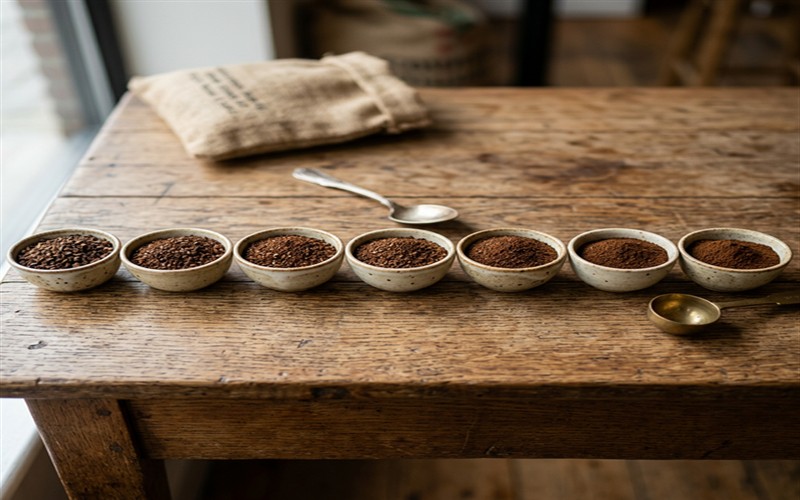
Grind categories overlap, and bags use different terminology. The photo above is illustrative. If you need a usable starting comparison, choose a product explicitly intended for your pot and examine its packaging; a decorative image cannot validate a grind.
Use touch as a coarse check
Look at a small dry sample on a clean surface and gently rub a little between clean fingers. Is it mostly powdery, visibly chunky, or gritty? Compare this to the maker’s description. Static, clumping and bean properties can affect how it feels; none alone establishes a precise particle size.
Do not choose a setting solely because coffee resembles table salt: salt itself varies. If a sample seems unlike the specified moka grind, adjust using your grinder’s instructions before preparing a fresh batch. Never inspect or adjust the grounds inside a hot, pressurized pot.
Record the exact grinder and reference
Identify the model, version and adjustment reference before using a click count. Encore is not Encore ESP or Encore ESP Pro; Mini Mill variants and other hand grinders should not share an assumed zero. Follow the manual when moving the burrs and do not force them closed to manufacture a reference point.
Use a maker’s moka starting point where available; otherwise use its instructions to reach the described medium-fine region and record your own setting. The grinder guide compares exact product identities without a universal click prescription.
Stalled, leaking or abnormally slow: stop first
If coffee fails to emerge, the valve vents or the pot leaks, stop heating and let it cool completely. Do not compensate with full heat, obstruct the valve or unscrew the hot pot. The Bialetti instruction sheet requires cooling before opening and checking correct assembly, moka-suitable grounds and loose fill. Persistent faults require manufacturer or retailer support before reuse.
After it is fully cool, check water level, basket fill, clean sealing surfaces, gasket and filter according to the manual. Powdery grounds may be one contributor; a blocked filter or damaged seal will not be repaired by a grinder setting. Only resume a comparison once the equipment and preparation are sound.
Thin or sharp: investigate before going finer
A weak or sharp cup can motivate a finer-grind comparison, but it does not prove the grind is too coarse. Record the coffee, water level, basket fill, heat and flow first. A different bean, excessive dilution or a preparation change can make the comparison misleading.
When the pot is functioning normally and those conditions are consistent, try one small, manual-permitted finer adjustment on the next brew. If you dislike a harsh cup, a coarser comparison may be useful under the same conditions. Taste and observed flow are clues to test together; neither guarantees a single cause.
Choose by the exact package
You can use suitable pre-ground coffee without buying a grinder. Check the exact format, pack and brewing recommendation: whole beans, capsules, machine-espresso grounds and moka grounds can appear under the same brand. Bialetti’s instruction sheet specifies coffee ground for moka. If the package is ambiguous, choose a clearly specified option or ask the maker rather than relying on a brand name.
Choose an exact product format before comparing brands or prices. The regular-coffee guide covers label checks, and the coffee selection guide provides further product context. A supermarket product can be a practical option when its package specifies suitable moka grounds.
A repeatable dial-in worksheet
| Step | Keep / record | Decision |
|---|---|---|
| 1. Establish the setup | Pot model/size; coffee and roast; exact grinder and reference | Check the pot’s manual and equipment condition before brewing. |
| 2. Prepare consistently | Loose basket fill, water level and initial water temperature | Follow the maker’s fill instructions. No overfilling or tamping. |
| 3. Observe with supervision | Heat setting; heating start; first coffee; normal stopping point | Record timing, but do not extend a stalled brew to reach a target. |
| 4. Compare the cup | Brewed amount if measured; any dilution; taste after cooling enough to drink | Describe the result rather than just writing “good” or “bad”. |
| 5. Make one change | One small grinder adjustment permitted by its manual | Keep the other conditions constant and record the outcome of the next brew. |
Example note: “Same pot, coffee and preparation as last brew; grind one step coarser; flow normal; less drying after the same dilution.” That is a useful observation, not proof that a specific setting works for every reader. There is no promised number of brews needed to find a setting you prefer.
Two relevant grinder examples
Compare workflow before buying. A manual grinder involves hand effort and batch-capacity checks. An electric grinder needs counter space and the correct electrical specification. If you also make machine espresso, assess that need separately from moka use. These examples illustrate two workflows; this guide does not report a comparative hands-on test.
TIMEMORE Chestnut C2S, black
Manual option. Check the exact C2S variant, capacity for your basket and maker’s adjustment instructions; do not import a C2 or C3 click prescription.
Check the exact C2S black listing on AmazonBaratza Encore ESP Pro ZCG595BLK, black
Electric option for a household considering multiple brew methods. It is a different model from the original Encore and Encore ESP; the additional adjustment range may be unnecessary for moka alone.
Check the exact ESP Pro black listing on AmazonAffiliate disclosure: As an Amazon Associate, we earn from qualifying purchases. Linked model identities checked October 8, 2026. Check the selected variant, seller, delivered contents, current price and availability on Amazon.
For a wider model comparison, continue to the exact-model grinder guide.
Moka grind questions
What grind size should I start with for a moka pot?
For Moka Express, Bialetti’s linked use-and-care guide recommends medium-fine grounds that feel gritty rather than powdery. Start there and follow your own model’s manual. No universal dial number or salt comparison can replace it.
Can I use espresso-labelled ground coffee?
Check what the label means and whether the exact product is intended for moka use. Some Bialetti web copy uses espresso wording, while the instruction sheet specifies moka-suitable grounds and warns against finely ground coffee. Do not assume a very fine machine-espresso grind is suitable just because the bag says espresso.
Does no crema mean my grind is too coarse?
No. A classic Moka Express is not a machine-espresso crema test. Bialetti distinguishes it from the Brikka’s special valve design. Judge a normally functioning brew by your recorded recipe and taste, rather than requiring a foam layer.
Must a moka brew take 4–5 minutes?
No universal time establishes the correct grind. Pot size, water start temperature and heat affect the total. Record warm-up and coffee flow separately; follow the manufacturer’s stopping instructions rather than extending heating to hit a target.
What if the safety valve vents or coffee does not emerge?
Stop heating, let the pot cool completely and inspect it using the manual. Check the water level, loose fill, filter and seal. Do not turn up the heat, open the hot pot or obstruct the valve. A persistent fault calls for manufacturer or retailer support before reuse.
Can I use the same setting in another pot size?
Keep medium-fine as a starting description where the maker recommends it, but record the new pot as a new setup. Basket, fill, water and heat conditions have changed. A setting that worked in one configuration is a reference to test, not a guaranteed match.
Sources and scope
- Bialetti Moka Express: use, grind description and model distinction
- Bialetti Moka Express instruction/warning sheet (Amazon-hosted PDF)
- Baratza: separate model-specific espresso adjustment systems
Sources reviewed October 8, 2026. The worksheet is an editorial comparison aid, not a controlled experiment or a guarantee of taste.