
As an Amazon Associate I earn from qualifying purchases. Amazon links on this page are affiliate links. Our disclosure. Check the selected version, seller and current price before ordering.
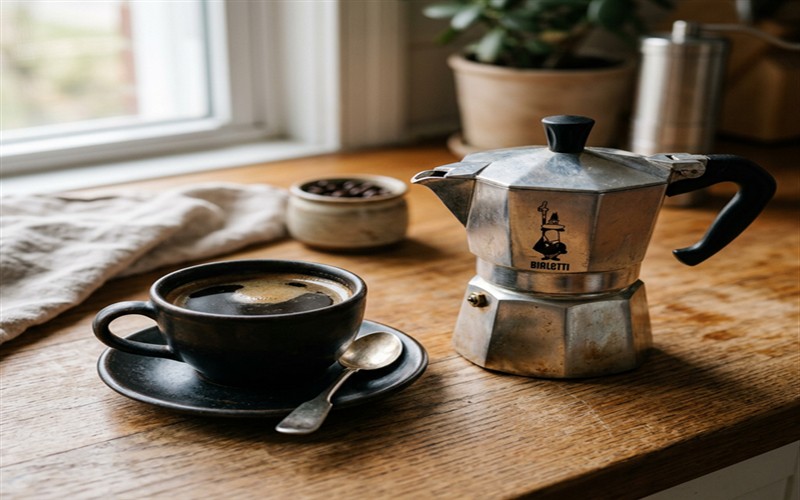
Start with what the cup is telling you
A bitter cup is a reason to check the brew, not proof of one chemical or timing error. Strong concentration, dark-roast flavor, stale residue, restricted flow and over-heating can feel different, but people describe them differently. The Specialty Coffee Association notes that the classic brewing chart is not a universal sensory boundary between good and bad coffee. Do not apply a filter-coffee extraction percentage, ratio or temperature as a fixed moka-pot target.
If you need a pot-specific walkthrough, read our five moka checks. Below is a broader seven-step diagnosis you can use without purchasing anything.
Seven checks before changing equipment
1. Compare strength with bitterness
Take a small sip, then dilute a second sip with a little hot water. If the second tastes more balanced, concentration may be part of what you disliked. Dilution changes strength after brewing; it does not repair blocked flow or burned residue.
2. Check the water level
For a Bialetti Moka Express, fill the boiler below the safety valve. Do not borrow a 1:16 filter-coffee ratio and partly fill the boiler to achieve it. Follow the capacity and instructions for your exact pot.
3. Inspect grind and the basket
Bialetti describes a medium-fine, gritty grind rather than powdery pump-espresso grounds. Fill the funnel loosely and level it without tamping. If your pot hesitates, leaks or vents at the safety valve, stop and check the assembly; do not raise the heat to force flow.
4. Watch the heat and finish
Use low-to-medium heat, keep a gas flame under the base, and remove the pot when brewing is complete according to its instructions. Avoid leaving finished coffee on the burner through prolonged sputtering. An exact number of minutes is not transferable across stoves and pot sizes.
5. Clean according to the pot maker
Old grounds and coffee residue can affect the next cup. Inspect the funnel, filter plate, gasket and upper column after the pot has cooled. Follow your model's cleaning instructions and use compatible replacement parts only when worn or damaged. Do not apply a universal vinegar, baking-soda or detergent routine to every pot.
6. Compare coffee, not a guaranteed roast rule
A very dark roast can taste more roast-forward; a different coffee may suit your preference. Neither single-origin branding nor a precise number of days after roasting guarantees sweetness. Compare two coffees in the same clean pot using the same preparation before blaming the equipment.
7. Change one thing at a time
Record the pot size, coffee, grind, heat level and when you remove the pot. Change one variable for the next brew. If the valve repeatedly releases steam, the joint leaks or the flow is abnormal, follow the manufacturer's troubleshooting guidance before further tasting experiments.
What if you brew another way?
Filter coffee and espresso have different brewing controls. The SCA's 18–22% extraction range is a certification criterion for tested home filter brewers, not a target we can transfer to a moka pot. Likewise, 195–205°F is an espresso-machine specification in a particular context, not a requirement to put a thermometer into a moka boiler. For filter coffee, use the brewer's recipe and adjust grind or contact time in small steps; for espresso, use machine-specific guidance. Our grind guide explains the differences.
Optional tools after the basic checks
These are comparison options tied to the checks above, not a ranked list or a promise that a purchase will remove bitterness. The Hario scale is a new sitewide ASIN; the grinder and Bialetti ground coffee are already listed elsewhere on this site.
Hario V60 Drip Scale, Black (New Model)
A scale can help record your coffee amount and compare repeat brews. Its timer is optional for moka; pot size and maker instructions still determine fill levels.
View Hario V60 Drip Scale, Black (New Model) on Amazon →Baratza Encore burr grinder
An existing site listing for adjustable whole-bean grinding. Consider it only if your current coffee is too powdery or you want to grind fresh beans; start at a moka-suitable texture.
View Baratza Encore burr grinder on Amazon →Bialetti Perfetto Moka Delicato ground coffee, 8.8 oz
An existing site listing for moka-labeled ground coffee. Use it as a taste comparison, not a guaranteed bitterness cure.
View Bialetti Perfetto Moka Delicato ground coffee, 8.8 oz on Amazon →Common questions
Does bitter coffee always mean over-extraction?
No. Coffee choice, concentration, residue and brewing conditions can all change the way bitterness is perceived. Taste alone does not prove one cause.
Should I use a 1:16 water-to-coffee ratio in my moka pot?
No. That ratio is commonly discussed for filter coffee and should not be applied to a moka pot by underfilling its boiler or funnel. Follow the pot maker's fill instructions.
Will a new grinder fix a bitter moka pot?
Only if unsuitable grounds or inconsistent adjustment are part of the problem. Check the water level, basket, seal, cleanliness, heat and flow first.
Sources and selection method
Brewing and safety checks come from Bialetti's Moka Express instructions and its grind guidance. The distinction between measured extraction and a universal taste rule follows the Specialty Coffee Association's brewing-chart discussion. We checked exact Amazon US product names on September 28, 2026; we did not conduct a controlled tasting test or verify live price, stock, seller or commission attribution.