
As an Amazon Associate I earn from qualifying purchases. Product buttons below are affiliate links. Check the exact model or package, seller, current price and stock before ordering. Full disclosure.
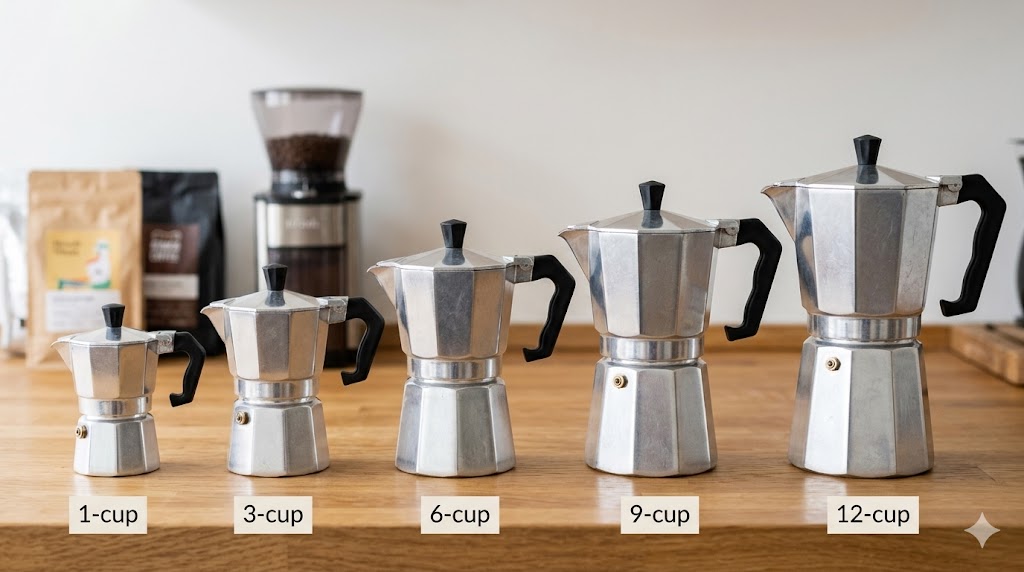
The funnel sets the dose, not the cup label
For a standard Bialetti Moka Express, fill the lower chamber to just below its safety valve, loosely fill and level the coffee funnel, and do not tamp. A “six-cup” label describes small servings, not six standard mugs or one universal coffee mass. Bialetti does not provide the fixed gram-and-tablespoon conversion that appeared in the previous version of this article.
To record a repeatable gram dose for your own pot and coffee, weigh what fills the funnel as directed. The mass can change with grind and beans even when the funnel looks equally full. See the tablespoons-versus-grams guide and the broader model size guide.
Bialetti Moka Express serving guide
These approximate brewed volumes come from Bialetti NZ's Moka Express chart. They describe the maker's models, not a guarantee for every brand or every brew. Bialetti NZ says actual output depends on the water and the grind or type of coffee. Its prose also describes an espresso cup as approximately 30 mL, while its table lists, for example, a three-cup model at about 130 mL. These are different descriptions: do not multiply the cup label by 30 and present that as a measured yield. Keep the maker's estimate and your observed batch in separate columns. The illustration is not a product comparison photograph.
| Label | Approximate brewed volume | Practical check |
|---|---|---|
| 1 cup | 60 mL | One very small serving |
| 2 cups | 90 mL | Compare with your usual cup |
| 3 cups | 130 mL | One modest or several small servings |
| 4 cups | 185 mL | Confirm the exact model |
| 6 cups | 250 mL | Still not six mugs |
| 9 cups | 410 mL | Larger shared batch |
| 12 cups | 595 mL | Check listing-volume discrepancy |
| 18 cups | 800 mL | Very large batch |
Bialetti warns against using a partially filled standard pot to make a smaller batch. Choose the size you will normally brew. Other designs may have a specific reducer; verify that feature for the exact model.
Record a dose without changing the fill rule
The useful gram number is the mass of the coffee that loosely fills your funnel as its maker directs. It is a record of that coffee and grind, not a target that should be forced into every three-cup or six-cup pot. Do not press extra grounds into the basket to reach a number from a chart.
- Start with a cool, dry pot and its correct funnel. Identify the exact model and instruction edition before preparing the normal, loosely filled funnel.
- If weighing helps, tare a dry weighing cup, transfer the prepared grounds into it and record the net mass. Return the grounds to the funnel loosely, without tamping; the maker's fill instruction still governs. If the transfer spills coffee, prepare and record again rather than topping up to a guessed mass.
- Follow the water-level and assembly directions for that model. The record sheet below does not replace its operating instructions. Never disassemble a hot or pressurized pot to make a measurement.
- Record the collected coffee separately from the water initially put in the base. Use a suitable measuring vessel for volume; if you record grams instead, keep that unit and do not silently relabel it as milliliters.
- Repeat with the same coffee and grind before comparing records. A new bean, a different grind or a replacement funnel means the old mass is a comparison point, not permission to underfill or compress the new coffee.
A tablespoon measures volume, not mass. See the tablespoons-versus-grams guide for that distinction. No dose or brew was measured for this article.
A reusable funnel and serving record
Copy these seven fields into a note. Leave unknown values blank. This is an editorial planning tool, not a manufacturer recipe or a test result.
| Record field | What to write | What it does not prove |
|---|---|---|
| Pot and funnel identity | Maker, model, cup label and instruction edition | The same cup label means the same basket across brands |
| Coffee and grind | Exact coffee, whole bean or ground, and grinder setting if used | A transferable grinder setting or a freshness score |
| Loose funnel dose | Net coffee mass in grams after the maker-directed fill | A universal gram recommendation |
| Base water setup | The model's stated fill level; note how you followed it | The eventual beverage volume |
| Collected brew | Your observed amount and its unit, separate from base water | Extraction yield, caffeine content or guaranteed future output |
| Serving plan | Number of people and amount of brewed coffee in each serving | That a moka cup equals a full drinking mug |
| Finished drink and next comparison | Post-brew milk or water additions, cup used, and the one change to compare next | A fixed latte recipe or permission to add milk to the boiler |
Illustrative arithmetic only: if a future measured batch were 240 mL and you divided it equally between two people, that would be 120 mL of brewed coffee each. It would not establish a 240 mL yield for a named pot, its coffee dose, or the size of either finished milk drink. No such batch was brewed here.
Optional scale for the dry coffee entry
A scale can help record net coffee mass; it cannot identify the correct basket fill or measure brew chemistry. The existing WACACO Exagram original listing is an optional example with a tare function. The manufacturer also lists Exagram variants: check the exact product rather than treating their specifications as interchangeable. We did not calibrate or test this scale, and current seller, stock and commission were not verified.
View the existing WACACO Exagram original listing on Amazon →Already own a suitable scale? Use it; buying another is unnecessary. The coffee scale guide explains selection checks. Measure dry grounds in a suitable cup, rather than putting a hot moka pot on a scale.
Choose the next step from the serving problem
| Your situation | Useful next step | Avoid this shortcut |
|---|---|---|
| Buying a pot for one regular drink | Start with the maker's model-specific estimate, your drinking cup and any post-brew additions. Check actual output once you own it. | Equating a six-cup label with six mugs |
| Your existing full batch is too much | For standard Moka Express, consider a smaller model for the usual batch; follow any reducer instructions only if your exact design has them. | Halving both the water and grounds in a standard pot |
| You want to share a batch | Record collected brew and divide that observed amount by the number of portions. Keep added milk or water separate. | Using boiler fill volume as guaranteed coffee yield |
| The coffee changed and the recorded grams differ | Record the new coffee and loosely filled funnel mass, then compare under the model's preparation rules. | Pressing or underfilling just to match the old gram entry |
For broader model and stove fit, use the moka size guide. This page is about recording dose and servings; it does not calculate caffeine, establish extraction strength or rank pot sizes by flavor.
Five exact Moka Express listings
These five Amazon US purchase paths reuse already identified sitewide ASINs. They are size examples, not a claim that one size tastes better. Confirm the selected variant and check the current seller and return terms.
Bialetti Moka Express 1-cup
The smallest linked Moka Express; Bialetti NZ lists about 60 mL brewed volume. This is a small serving, not a mug.
View exact Bialetti Moka Express 1-cup listing on Amazon →Bialetti Moka Express 3-cup
A three-small-cup option. Bialetti NZ lists about 130 mL brewed volume; follow this pot's funnel and water marks.
View exact Bialetti Moka Express 3-cup listing on Amazon →Bialetti Moka Express 6-cup
A six-small-cup option. The maker lists about 250 mL brewed volume, which still may be less than a large mug.
View exact Bialetti Moka Express 6-cup listing on Amazon →Bialetti Moka Express 9-cup
A larger batch option. Bialetti NZ lists about 410 mL; check how many small servings you actually need.
View exact Bialetti Moka Express 9-cup listing on Amazon →Bialetti Moka Express 12-cup
Bialetti NZ lists about 595 mL brewed volume, while the Amazon US title shows a different nominal volume. Confirm the exact variant and manufacturer information before checkout.
View exact Bialetti Moka Express 12-cup listing on Amazon →Common questions
How many grams for a three-cup moka pot?
There is no maker-backed universal gram number for every three-cup pot and coffee. Follow the exact funnel-fill instruction, then record that loosely filled coffee mass if you want a repeatable baseline.
Can I brew half a batch in a six-cup Moka Express?
Bialetti advises against under-filling a standard Moka Express. Choose a smaller pot for a smaller routine batch; a reducer is relevant only when the exact model has instructions for it.
Are moka cups the same as drinking mugs?
No. Cup labels, maker-stated approximate output and your measured collected brew are different records. Use the exact model estimate for planning and measure your own batch instead of assuming a label equals a full mug.
Should a new coffee match the gram dose of the previous bag?
Not necessarily. Record the new coffee and grind and follow the same model-specific loose-fill rule. Do not press extra grounds or deliberately underfill just to reproduce the old mass.
Sources and scope
Reviewed October 21, 2026. Bialetti NZ's Moka Express page supplies the approximate size table, loose-fill instructions and output caveat; its troubleshooting FAQ covers under-filling and residual water. The linked Moka Express instruction PDF has an 18-cup cover; its English section supports the untamped funnel and valve-level instructions, not a new dose chart or an exact instruction edition for every linked size.
WACACO's Exagram page supplies the optional scale's tare-function statement. Its existing Amazon US destination was read for original Exagram identity on this review date; this is not a calibration, seller, inventory, or commission check. The five Moka Express size links are existing purchase paths, not newly verified exact retail offers in this update. The worksheet, serving decisions and hypothetical arithmetic are editorial aids, not a performed brew, manufacturer endorsement or fixed output promise.