
As an Amazon Associate I earn from qualifying purchases. The five product buttons below are affiliate links. Check the exact variant, seller, current price and stock before ordering. Full disclosure.
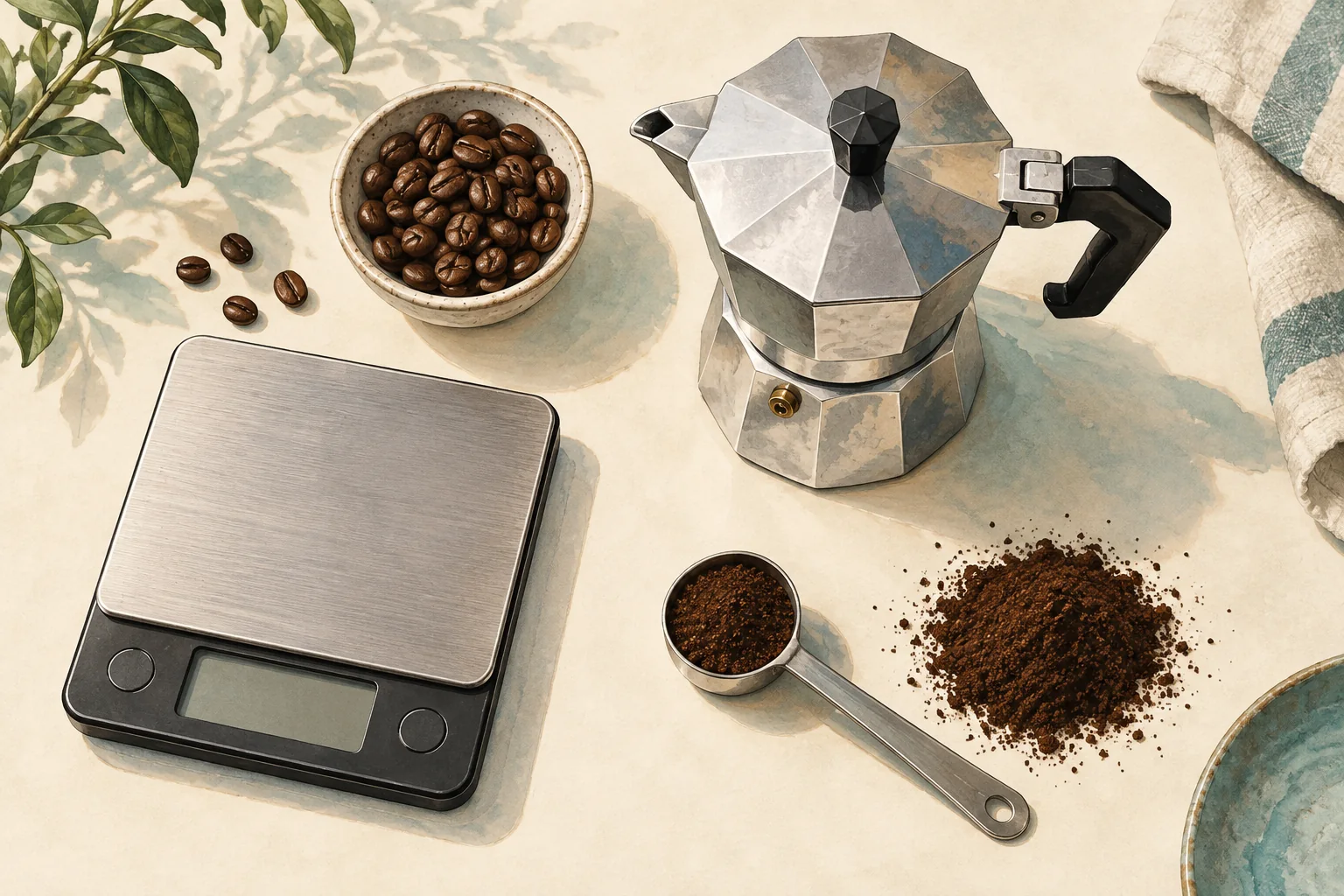
There is no fixed tablespoons-to-grams rule
A tablespoon is a volume measure. Grams measure mass. Whole beans, coarse grounds and fine grounds leave different spaces inside the same spoon, and a heaped spoon differs from a level one. The old idea that one tablespoon always equals one cup is incorrect: cup size and brewing method are separate choices.
For a moka pot, follow your maker's water and funnel-fill instructions first. Level the grounds without tamping. A scale can help you record what that properly filled funnel weighs for your coffee and model; it does not replace the model's fill limits. See the first-brew method and serving-size guide.
A practical moka measurement routine
- Check the exact pot manual. Add water to the specified level below the safety valve; fill the funnel loosely and level it without compressing the coffee.
- If you want a repeatable mass, set an empty cup or bowl on a scale and tare it. Weigh the beans or grounds that fill your funnel as intended, then write down that number.
- On a later brew, use the same pot, coffee form and fill level. Change one variable at a time, such as grind size, while observing the maker's safety instructions.
A three-cup label is not three standard mugs. Different moka makers also publish different nominal capacities, so a universal dose table would imply accuracy this guide cannot support.
Keep filter-coffee ratios separate
For drip or pour-over, a brewing ratio compares ground-coffee mass with brewing-water mass. As a simple arithmetic example, 15 g of coffee with 250 g of water is about 1:16.7. This is an example of how to calculate a ratio, not a prescription for a moka funnel. The coffee-water chart covers other methods.
The Specialty Coffee Association's two-cup pour-over practice uses a gram scale and specifies its own coffee and water amounts. Its filter-brewer recipe should not be transplanted to a pressurized stovetop pot with a fixed funnel and boiler.
Five optional measuring tools
Choose a scale if you want mass in grams. Choose a scoop if you want a repeatable volume; calibrate that scoop on a scale once if you need to know its mass for your coffee. Display resolution is not a guarantee of real-world accuracy, and no tool is required to fill a moka funnel correctly.
Greater Goods digital espresso scale
A compact 750 g-capacity scale whose listing states 0.1 g display increments. Check that your cup or dosing vessel fits the platform.
View Greater Goods digital espresso scale on Amazon →Weigh Gram digital pocket scale
A 600 g-capacity pocket scale with 0.1 g display increments. Use a small bowl or cup and tare it before adding beans.
View Weigh Gram digital pocket scale on Amazon →Maestri House S3 coffee scale
A coffee scale with a timer and 3 kg stated capacity. The timer is useful if you also brew pour-over; it is not required for moka coffee.
View Maestri House S3 coffee scale on Amazon →Chef Craft 2-tablespoon stainless scoop
A simple 2-tablespoon volume scoop. Level it consistently; two scoops do not imply one fixed coffee mass or one finished cup.
View Chef Craft 2-tablespoon stainless scoop on Amazon →15 mL stainless coffee scoop
A one-tablespoon volume option for small doses. Coffee weight still changes with grind and how full you fill the scoop.
View 15 mL stainless coffee scoop on Amazon →Common questions
How many grams are in a tablespoon of coffee?
There is no reliable universal number. Weigh one level scoop of your own whole beans or grounds, then record it for that coffee and scoop.
Do I need a 0.1 g coffee scale?
No. A scale makes notes more repeatable, but the pot maker's water and funnel-fill instructions remain the brewing reference. A compact scale must also fit the vessel you weigh.
Does one moka cup equal a full mug?
No. Moka sizes describe small servings. Check your model's nominal capacity rather than converting its cup label to standard mugs.
Sources and scope
Bialetti's Moka Express instructions guide the funnel and water method. The Specialty Coffee Association's pour-over practice illustrates weighing for a different brewing method. The five Amazon US product pages returned matching titles on September 28, 2026. Product identity does not establish live price, stock, seller, scale calibration or commission attribution. This is desk research, not hands-on testing.