
As an Amazon Associate I earn from qualifying purchases. The one optional product button below is an affiliate link. Check the exact variant, seller, current price and stock before ordering. Full disclosure.
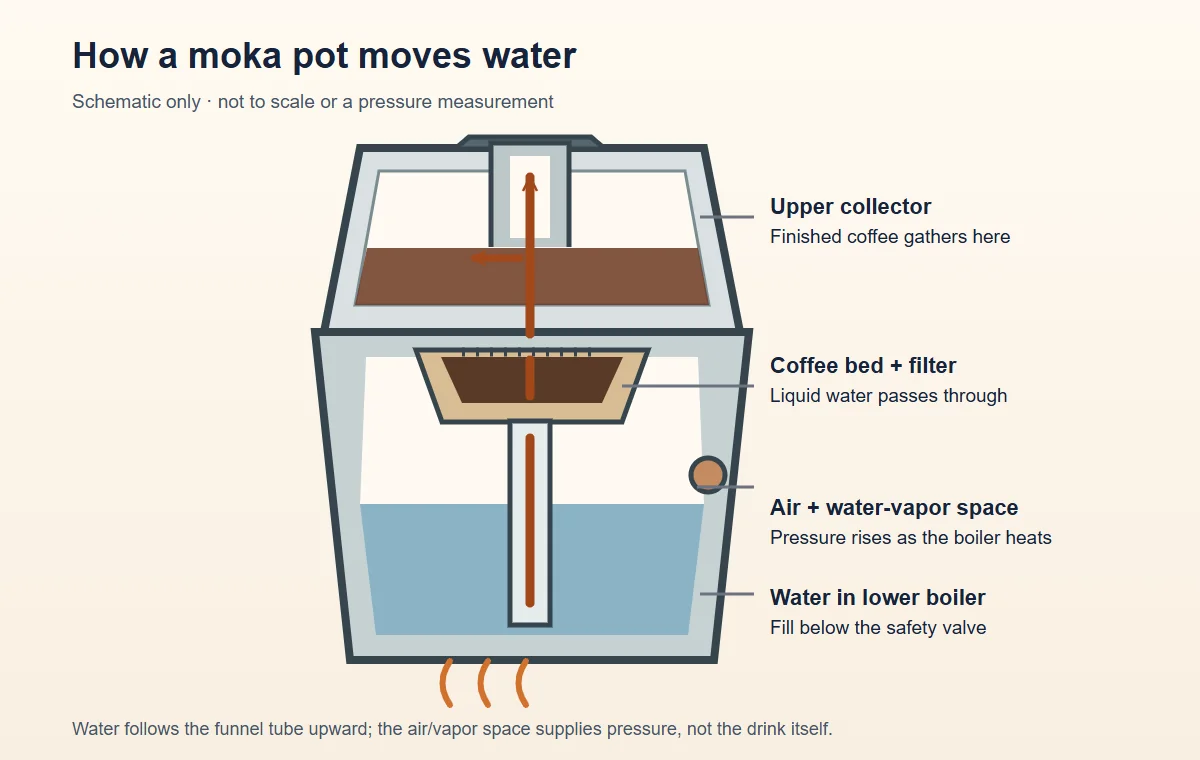
The short answer: pressure moves liquid water
A moka pot has a lower boiler, a funnel-shaped coffee basket, a filter plate and an upper collector. As the boiler heats, pressure in its trapped air and water-vapor space rises. That pressure pushes liquid water up the funnel tube, through the coffee bed and filter, then through the central spout into the top chamber. It is misleading to say that pure steam does the main brewing through the grounds.
Published experimental and modeling work describes a changing pressure and temperature history, not one fixed value for every pot and stove. The resistance of the coffee bed and the geometry of the pot matter. Our diagram leaves out many details so the path stays readable.
What happens during a brew
- Heat-up: the lower chamber warms. The gas space above the water contains air and water vapor; its pressure changes as temperature rises.
- First flow: once the pressure difference can overcome the water column and coffee-bed resistance, liquid water moves up the funnel and through the grounds. Coffee appears in the collector.
- Continuing flow: the water level in the boiler falls while gas space grows. Pressure, temperature and flow are not constant.
- Finish: as the supply of liquid water dwindles, gas and vapor can enter the flow path and produce sputtering. Remove the pot according to its maker's instructions rather than leaving finished coffee to boil.
For practical timing and finish signs, read our moka timing guide. A stopwatch cannot diagnose a blocked filter or a leaking gasket.
Why fill level, grind and the safety valve matter
Bialetti instructs users to keep water below the safety valve, fill the coffee funnel loosely and avoid tamping. A powdery, tightly packed bed can restrict flow; stray grounds on the rim can interfere with sealing. Clean the filter and gasket as directed. If the safety valve vents unexpectedly or the pot leaks, turn off the heat and let it cool before inspecting it. The valve is a safety device, not a normal brew indicator.
The old habit of quoting one valve-opening pressure or one “ideal” moka brew pressure is not enough to assess an individual pot. We do not measure pressure in readers' equipment. Follow your exact model's manual and the troubleshooting guide for abnormal behavior.
Why this is different from an espresso machine
Both methods drive water through ground coffee, but they use different equipment and extraction conditions. A moka pot heats its sealed lower chamber on a stove; an espresso machine uses a pump or other pressure system with different control. Moka coffee can be concentrated, but it should not be described as identical to pump espresso or assigned a universal pressure ratio. See the moka-versus-espresso explainer for serving terminology.
One exact pot example
The Bialetti Moka Express 3-cup is an example of the standard aluminum design described here. Bialetti states an approximate 130 mL brewed volume; that is a small-serving label, not three ordinary mugs. You do not need to buy a new pot to understand the mechanism.
Bialetti Moka Express, aluminum, 3-cup
Check the current selected size and your cooktop type. The standard aluminum Moka Express is not directly induction-compatible.
View exact Bialetti Moka Express 3-cup listing on Amazon →Common questions
Does steam pass through the grounds?
During the main brew, pressure pushes liquid water through the coffee. A gas/vapor surge can occur near the end.
How much pressure does a moka pot make?
It varies across models and brew stages. A number from one experiment is not a universal operating value or a safety-valve specification for every pot.
Does a harder boil make stronger coffee?
Not reliably. Follow the maker's low-to-medium heat guidance and remove the pot when brewing completes; do not try to force a blocked pot with more heat.
Sources and scope
Navarini and colleagues' experimental moka study describes measured thermodynamic behavior of one stovetop setup. The University of Vienna's moka physics explanation distinguishes contributions from trapped air and water vapor. Bialetti's Moka Express page supports fill, grind and care guidance. The Amazon US product page for the one linked ASIN showed a matching Moka Express 3-cup title in the latest accessible page check. This article does not claim hands-on pressure or taste testing, a fixed brew time, current price, stock, seller or commission result.