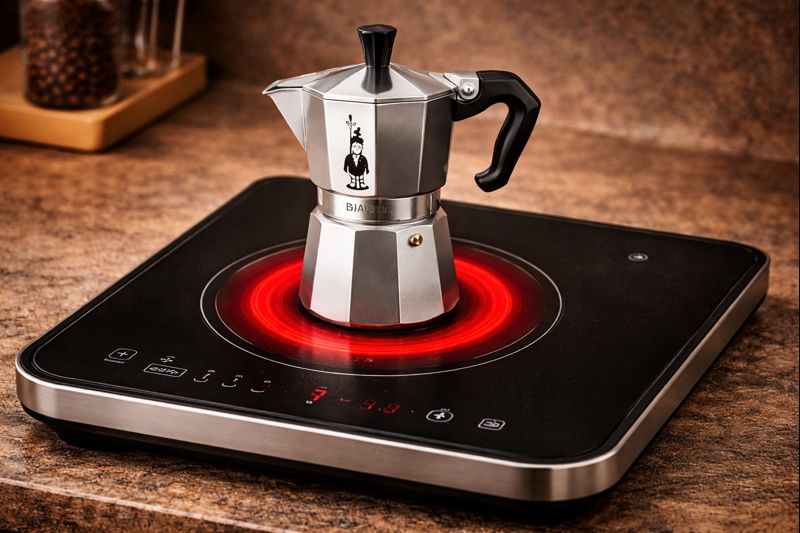
Quick Answer: Does It Work?
Electric Coil
Works great. Use medium-low heat.
Glass-Top
Works with precautions. May scratch.
Induction
Needs special pot or adapter.
Table of Contents
1. Moka Pot on Electric Coil Stoves
Verdict: Works perfectly! Electric coil stoves are great for moka pots.
Traditional electric coil stoves work excellently with moka pots. The coils provide consistent, even heat that's perfect for building the steady pressure needed for good extraction.
How to Use
Choose the right burner size. Use the smallest burner that your moka pot fits on. This ensures efficient heat transfer and prevents the handle from overheating.
Center the moka pot. Place it directly in the center of the coil for even heating. Off-center placement causes uneven extraction.
Set to medium-low heat. Use setting 3-4 out of 10. Electric coils retain heat well, so you need less than you might expect.
Wait slightly longer. Electric coils take 1-2 minutes longer than gas. Expect 5-8 minutes total brew time.
Remove when done. When you hear sputtering, remove immediately. Consider removing the pot from the still-hot burner to stop extraction.
Pros of Electric Coil
- + Even, consistent heat distribution
- + Works with all moka pot materials
- + Stable - pot won't tip
- + Retains heat well (less fluctuation)
- + Safe for aluminum pots
Things to Note
- - Slower heat-up than gas
- - Less precise temperature control
- - Stays hot after turning off
- - May need to remove pot to stop cooking
2. Moka Pot on Glass-Top Stoves
Verdict: Works, but requires extra care to prevent scratches and ensure good contact.
Glass-top (ceramic) stoves can be used with moka pots, but there are important precautions to follow. The smooth surface and the shape of traditional moka pots create some unique challenges.
Potential Issues
Scratching Risk
Traditional aluminum moka pots have rough bottom edges that can scratch glass surfaces. The octagonal shape also creates point contact that concentrates pressure.
Solution: Use stainless steel pots or a heat diffuser.
Poor Heat Contact
The octagonal bottom of classic moka pots doesn't sit flat on glass surfaces, reducing heat transfer efficiency and increasing brew time.
Solution: Use flat-bottom moka pots or heat diffuser.
How to Use Safely
Never slide the pot. Always lift and place. Sliding causes scratches. This is the most important rule.
Check the bottom. Ensure no debris or coffee grounds are stuck to the pot bottom before placing on glass.
Consider a heat diffuser. A thin metal disc between pot and glass protects the surface and improves heat distribution.
Use stainless steel. Stainless steel moka pots have smoother, flatter bottoms that are safer for glass surfaces.
Best Option: Heat Diffuser
A heat diffuser (also called a heat spreader or simmer plate) is a thin metal disc that sits between your moka pot and the glass surface. It protects against scratches, distributes heat evenly, and works with any moka pot. They cost around $10-15 and are highly recommended for glass-top stoves.
3. Moka Pot on Induction Cooktops
Verdict: Traditional aluminum moka pots DON'T work on induction. You need special solutions.
Induction cooktops work by creating a magnetic field that heats ferromagnetic materials directly. Traditional aluminum moka pots aren't magnetic, so they simply won't heat up on induction.
Two Solutions
Solution 1: Induction-Compatible Moka Pot
Best OptionBuy a stainless steel moka pot designed for induction. These have a ferromagnetic base that works directly on induction cooktops.
Recommended Models:
- Bialetti Venus - Elegant stainless steel design
- Bialetti Musa - Traditional look in stainless
- Grosche Milano Steel - Budget-friendly option
Price: $30-60, similar to regular moka pots
Solution 2: Induction Adapter Disc
Good AlternativeA magnetic disc that sits on the induction surface and transfers heat to your existing moka pot. Works with any pot material.
How It Works:
- - Disc heats via induction
- - Heat transfers to moka pot
- - Works like a hot plate
Price: $15-25 for quality adapter
Note: Slightly less efficient and slower than direct induction.
Quick Compatibility Test
Not sure if your moka pot works on induction? Do the magnet test:
The Magnet Test
Hold a magnet to the bottom of your moka pot. If it sticks firmly, your pot will work on induction. If it doesn't stick or sticks weakly, you need an induction-compatible pot or adapter.
4. Best Heat Settings by Stove Type
Finding the right heat setting is crucial for good moka pot coffee. Here's a guide for each stove type:
| Stove Type | Recommended Setting | Brew Time | Notes |
|---|---|---|---|
| Gas | Low-Medium (flame visible) | 4-6 min | Flame should not wrap around sides |
| Electric Coil | 3-4 out of 10 | 5-8 min | Coil should glow dull red, not bright |
| Glass-Top | 3-4 out of 10 | 5-8 min | Similar to electric coil |
| Induction | Low-Medium (power 3-5) | 4-6 min | Induction heats faster - start lower |
Signs of Correct Heat
- + Coffee flows steadily (not explosively)
- + Golden-brown color emerging
- + Brew completes in 4-8 minutes
- + No burnt smell
Signs Heat Is Too High
- - Coffee spurts or explodes out
- - Very pale, watery coffee
- - Brew finishes in under 3 minutes
- - Bitter, burnt taste
5. Tips for Better Results on Electric
Tip 1: Use Pre-Heated Water
Electric stoves are slower to heat than gas. Using hot water from a kettle (not boiling) can cut 2-3 minutes off brew time and prevent the coffee grounds from "cooking" while waiting for the water to heat.
Tip 2: Remove From Burner When Done
Electric coils stay hot after turning off. When your coffee is done (sputtering sound), lift the moka pot completely off the burner. This stops extraction and prevents over-cooking.
Tip 3: Cool the Base Immediately
After removing from heat, cool the bottom chamber by running under cold water or placing on a cold, wet towel. This stops extraction instantly and prevents bitter coffee.
Tip 4: Match Burner to Pot Size
Use the smallest burner that your moka pot fits on. A large burner wastes energy and can overheat the handle. The pot base should mostly cover the heating element.
Tip 5: Watch the First Few Brews
Electric stoves vary in intensity. Your first few brews, stay nearby and watch the process. Note the setting that produces steady (not explosive) flow, then use that setting consistently.
6. Troubleshooting Common Problems
Problem: Coffee won't come out
Possible causes:
- - Heat too low
- - Pot not centered on burner
- - Grind too fine (clogging)
- - Gasket worn (pressure escaping)
Solutions:
- - Increase heat slightly
- - Center pot on burner
- - Use coarser grind
- - Replace gasket
Problem: Takes forever to brew
Possible causes:
- - Heat setting too low
- - Starting with cold water
- - Poor heat contact (glass-top)
- - Wrong burner size
Solutions:
- - Increase to medium-low
- - Use pre-heated water
- - Use heat diffuser
- - Use appropriate burner
Problem: Coffee tastes burnt/bitter
Possible causes:
- - Heat too high
- - Left on heat too long
- - Residual heat after turning off
- - Grind too fine
Solutions:
- - Reduce heat setting
- - Remove at first sputter
- - Remove pot from hot burner
- - Use coarser grind
Problem: Uneven heating (one side hotter)
Possible causes:
- - Pot not centered
- - Warped coil element
- - Uneven pot bottom
- - Burner too large
Solutions:
- - Center carefully
- - Try different burner
- - Use heat diffuser
- - Use appropriate size burner
7. Best Moka Pots for Electric Stoves
For All Electric Stoves (Coil & Glass-Top)
Bialetti Moka Express (Classic)
The original and best-selling. Works perfectly on electric coil stoves. For glass-top, use with a heat diffuser.
- - Price: ~$35-40
- - Material: Aluminum
- - Sizes: 1-12 cup
Bialetti Venus (Stainless Steel)
Stainless steel version with smooth, flat bottom. Better for glass-top stoves. Also works on induction.
- - Price: ~$45-55
- - Material: Stainless Steel
- - Induction: Yes
For Induction Stoves (Must Be Magnetic)
Bialetti Venus
Beautiful stainless steel design. Works on all stovetops including induction.
View on AmazonGet the Right Moka Pot for Your Stove
Whether you have gas, electric, glass-top, or induction, there's a perfect Bialetti for you. The Venus works on ALL stove types including induction.
8. Frequently Asked Questions
Yes, moka pots work perfectly on electric coil stoves. Use medium-low heat (setting 3-4 out of 10) and center the pot on the burner. Electric stoves take slightly longer to heat than gas but produce excellent results.
Yes, but with precautions. Traditional aluminum moka pots can scratch glass surfaces. Use a heat diffuser, always lift (never slide), and consider a stainless steel moka pot for best results on glass-top stoves.
Traditional aluminum moka pots don't work on induction because they're not magnetic. You need either a stainless steel moka pot designed for induction (like Bialetti Venus) or an induction adapter disc to use with your regular pot.
Use medium-low heat, typically setting 3-4 out of 10 on your electric stove dial. Electric stoves retain heat longer than gas, so slightly lower settings work well. The coil should glow dull red, not bright orange. Never use high heat.
Common causes include: heat too low (increase slightly), pot not centered on burner, burner size mismatch (use smallest burner that fits), worn gasket (pressure escaping), or coffee ground too fine. Electric coil stoves may also have uneven heating spots.
Yes. Traditional aluminum moka pots won't work on induction because they aren't magnetic. Buy a stainless steel induction-compatible moka pot (like Bialetti Venus or Musa) or use an induction adapter disc with your regular moka pot.
Gas offers faster heat-up and more precise control, which many prefer for moka pots. However, electric stoves work perfectly well - they just take slightly longer and require learning the right settings. Both produce excellent coffee.
A moka pot typically takes 5-8 minutes on an electric stove, compared to 4-6 minutes on gas. Electric coil stoves are slower to heat but retain heat longer. Using pre-heated water can reduce brew time by 2-3 minutes.
Related Articles
How Long Does a Moka Pot Take?
Complete timing guide by size and stove type.
SCIENCE GUIDEHow Does a Moka Pot Work?
Understand the physics behind moka pot brewing and heat transfer.
BEGINNER'S GUIDEWhat Is a Moka Pot? Complete Guide
Aluminum vs stainless steel and which works on your stove.
DOSING GUIDEHow Much Coffee for Moka Pot?
Complete size chart with grams and tablespoons.
Affiliate Disclosure
Art de Vivre Coffee is a participant in the Amazon Services LLC Associates Program. When you purchase through our links, we may earn a small commission at no extra cost to you.